From camera and instruction to robot action
Full architecture diagram → We study only the middle part. The network keeps a set of vectors representing the action about to be generated. Each layer reads the image and the text, updates these vectors, and at the end they are turned into arm commands.
Yes: changing one word makes the action vectors diverge layer by layer
So “language never enters the network” is ruled out. But note: a changed vector does not mean the right object is chosen; the arm may still go to the same thing, and the percentage is not a score of how much the model understood.
“Pick up the milk” in four layouts: it follows position
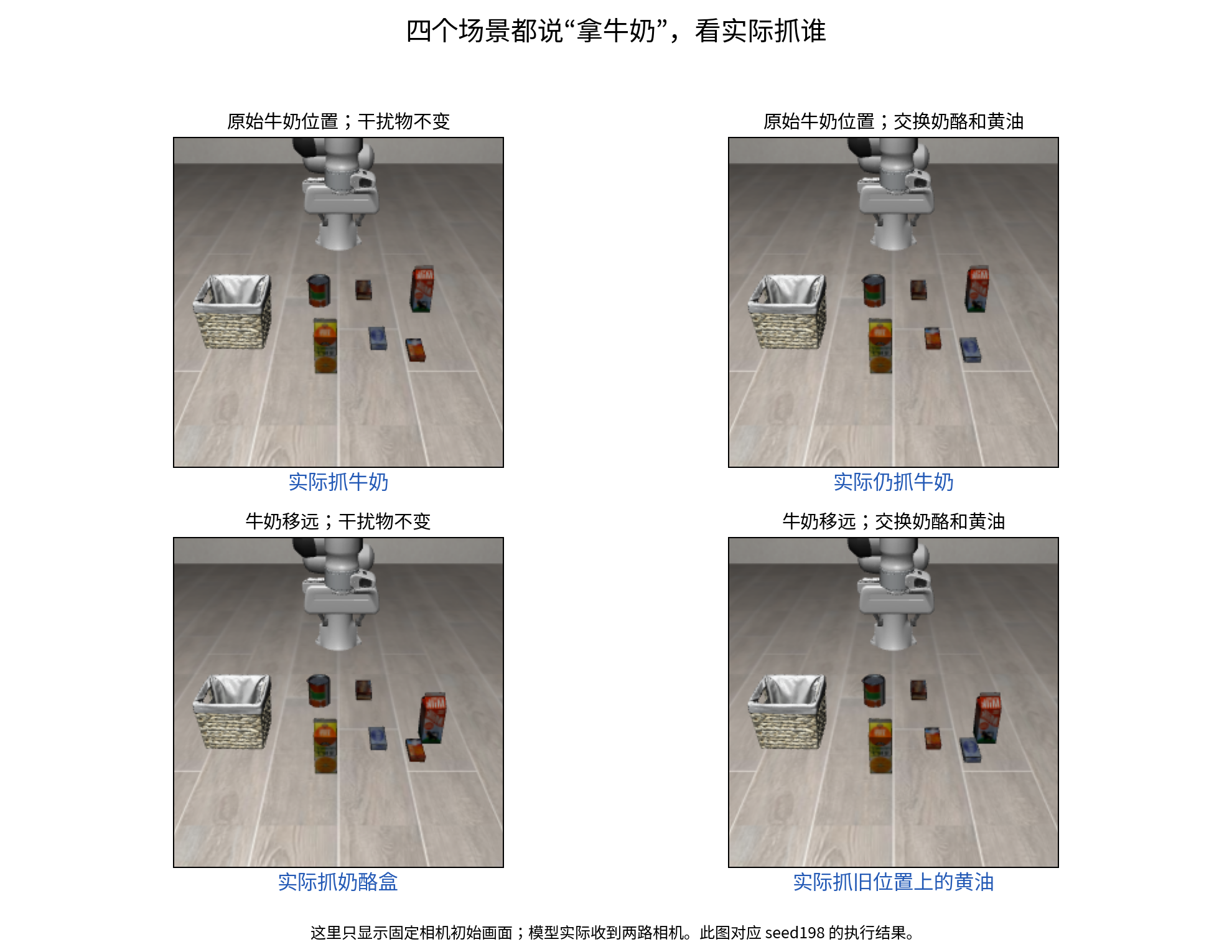
After the milk is moved away, the arm picks the cream cheese. When we then swap the cream cheese and the butter, it does not follow the cream cheese; it picks the butter sitting where the cream cheese used to be. The choice is driven more by that location than by the name in the instruction.
It is not deaf in general: in another scene, the same image with “bowl” picks the bowl and with “wine bottle” picks the bottle. The problem is that in some layouts, position overrides language.
Which internal information actually decides the target?
| What we swapped | Internal vectors | Object picked |
|---|---|---|
| Action vectors at layer 12, from a run that correctly picked milk | changed | same still cream cheese |
| Action vectors at layer 30, same source | changed | pushed picks butter (now at the milk's old spot), still not milk |
| Layer-36 text for “milk box” ↔ “cream cheese” (first query only), MLP response frozen | changed | same each keeps its original target |
This asks: does this piece of internal information merely change, or does it decide which object is picked? So far, text swaps give the former; swapping action vectors can only push the target, and what pushes it looks like position, not language.
Reply from the Cosmos discussion: a common failure, not unique to this model
Weak language sensitivity appears to be a common failure mode among open-source VLA/WAM policies after task-specific SFT. We observed similar behavior in the LIBERO-finetuned checkpoints of Cosmos3, π0.5, and LingBot-VA. … This is consistent with the broader problem of policies relying on familiar visual context more strongly than language instructions.
| Model | Same gripper direction under close/open swap |
|---|---|
| Cosmos3 | 180 / 180 |
| π0.5 | 180 / 180 |
| LingBot-VA | 180 / 180 |
Suggested mitigation directions are CAG, CAST and CounterAlign, none yet validated on this checkpoint. See discussion #369
Why don't the language-driven changes move the target choice?
We have ruled out “language never gets in”. Next we check whether the target is already fixed by image and position in earlier layers, so that later language information can no longer change it.